FinOps · 8 min read
AWS Cost Optimization: A Practical Infrastructure Review Checklist
A repeatable way to examine cloud spend without reducing the reliability signals your team needs.
Fundamentals and why this matters
An AWS cost review is not a hunt for the lowest bill. It is a structured comparison between what a workload needs and what is currently provisioned. Start from account, product, environment, owner, and usage context. Cost Explorer is useful for trend and service analysis; the Cost and Usage Report (CUR) is the detailed source for allocation work; AWS Budgets provides thresholds and forecasts; Compute Optimizer and Trusted Advisor offer signals, not automatic decisions. A review should distinguish a temporary spike, a growth-driven increase, and persistent waste before changing capacity.
Architecture and important components
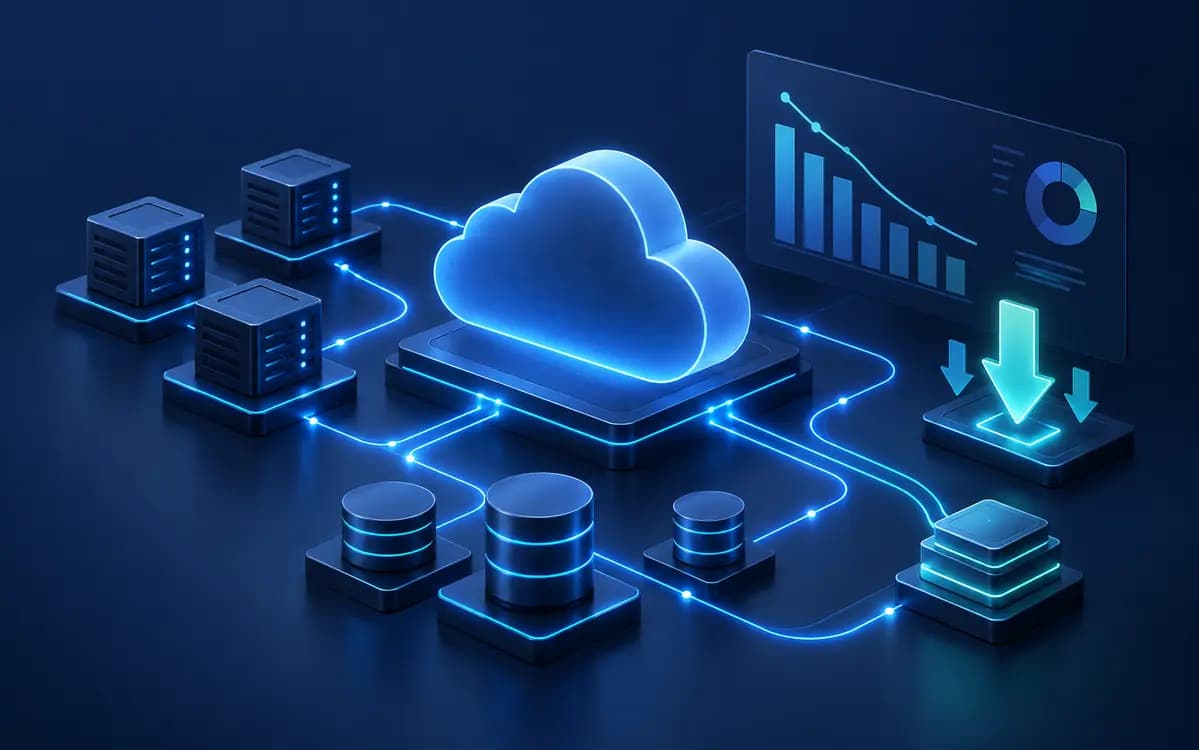
Build a cost data path before making recommendations: consolidated billing and cost allocation tags feed CUR into an analytics store; Cost Explorer gives fast investigation; budgets and anomaly alerts notify owners; service metrics explain whether spend bought useful throughput. Examine EC2 and Auto Scaling groups with CPU, memory, queue depth, and request rate together. Review Fargate task size and running hours, EBS type and unattached volumes, S3 class and lifecycle, RDS capacity and storage, NAT Gateway processing, cross-AZ and internet transfer, CloudWatch retention and ingestion. Each item has a technical owner and an action date.
Production implementation guidance
Run the review in passes. First, enforce tags such as application, environment, owner, and cost-center on new resources. Second, identify idle or orphaned resources: stopped-instance EBS volumes, unused Elastic IPs, old snapshots, idle load balancers, empty NAT paths, and non-production environments that run overnight. Third, right-size from at least several weeks of utilization rather than a single chart. Fourth, use Savings Plans or Reserved Instances only for stable baselines, and use Spot capacity only where interruption handling is designed. Fifth, add S3 lifecycle rules and review data-transfer routes before moving data across regions or availability zones.
Security and change-control considerations
Never delete backups, logs, or security telemetry only because they are expensive. Classify retention requirements first, keep immutable or compliance evidence separate, and test restoration before reducing backup frequency. Cost access should use least-privilege reporting roles. Tagging data can expose business context, so limit who can export detailed CUR data. When changing instance families, network paths, or database tiers, use a staged rollout and an explicit rollback plan.
Performance, monitoring, and operational considerations
Treat FinOps as an engineering routine. Publish a monthly owner-facing report, review top deltas weekly, and add cost impact to architecture decisions and change reviews. Pair billing data with CloudWatch, application latency, error rate, and customer traffic. If a resource is expensive but protects a defined SLO, make that trade-off visible rather than hiding it in a generic savings target. Track realized changes after implementation because an unused recommendation is not a saving.
Production delivery and verification
Before changing a live $aws cost optimization: a practical infrastructure review checklist design, record the current baseline: ownership, dependency map, service objective, capacity or policy limit, and the signals that would prove the change helped. A change without a baseline is difficult to validate and easy to misattribute after the next deployment or traffic shift.
Make the smallest reversible change first. Test it in a representative non-production environment, then release with a bounded blast radius, a named owner, and a rollback condition. Change windows are not a substitute for safety; the practical controls are an identified previous state, compatible data or configuration, and a clear decision point for stopping the rollout.
During and after release, correlate infrastructure signals with the user journey. Watch error rate, latency, saturation, availability, and the workload-specific signal that prompted the work. Record the observed outcome in the engineering decision log. This turns a one-off fix into operational knowledge that can be reused during planning, incident response, and the next review.
Finally, keep the runbook current. It should state what normal looks like, what breaks first, who owns the dependency, how to collect evidence, and which action is safe under pressure. Good documentation is concise enough to use during an incident and specific enough to prevent an unsafe guess.
Decision guidance
Prioritize changes by confidence, impact, reversibility, and risk. Removing an unattached volume is low risk after validation; changing database capacity or a production NAT topology is not. The best review produces a backlog with owners, expected effect, verification metrics, and a decision record—not a one-time spreadsheet.
Related technical reading: Cloud Cost Optimization Without Compromising Performance · Cloud Monitoring Strategy: Metrics, Logs, Traces and Alerting
Practical implementation checklist
- Confirm cost allocation tags and account ownership.
- Compare CUR trends with traffic, utilization, and deployment changes.
- Review EC2, Fargate, EBS, S3, RDS, NAT Gateway, data transfer, and CloudWatch separately.
- Validate backup, logging, and recovery requirements before cleanup.
- Measure the result and keep a record of accepted trade-offs.
Frequently asked questions
Should Savings Plans be purchased before rightsizing?
Usually no. Establish the stable compute baseline first; commitments should cover predictable use, while variable demand remains on flexible capacity.
Why can a low-CPU EC2 instance still be necessary?
CPU is only one signal. Memory, network throughput, connection count, scheduled work, latency headroom, and failover capacity can justify an instance.
What is the fastest safe first step?
Improve tagging and visibility, then validate clearly idle resources. Those steps create repeatable decision quality without altering production architecture.