Security · 8 min read
DevSecOps: Adding Security to Your CI/CD Pipeline
Security controls work best when they are fast, contextual, and part of normal delivery.
Fundamentals and why this matters
DevSecOps means security controls participate in normal delivery with clear ownership and useful feedback. It is not a pile of scanners at the end of a pipeline. The objective is to prevent high-impact issues early, create evidence of what was built and deployed, protect delivery identities, and give teams a practical remediation path when a control finds risk.
Architecture and important components
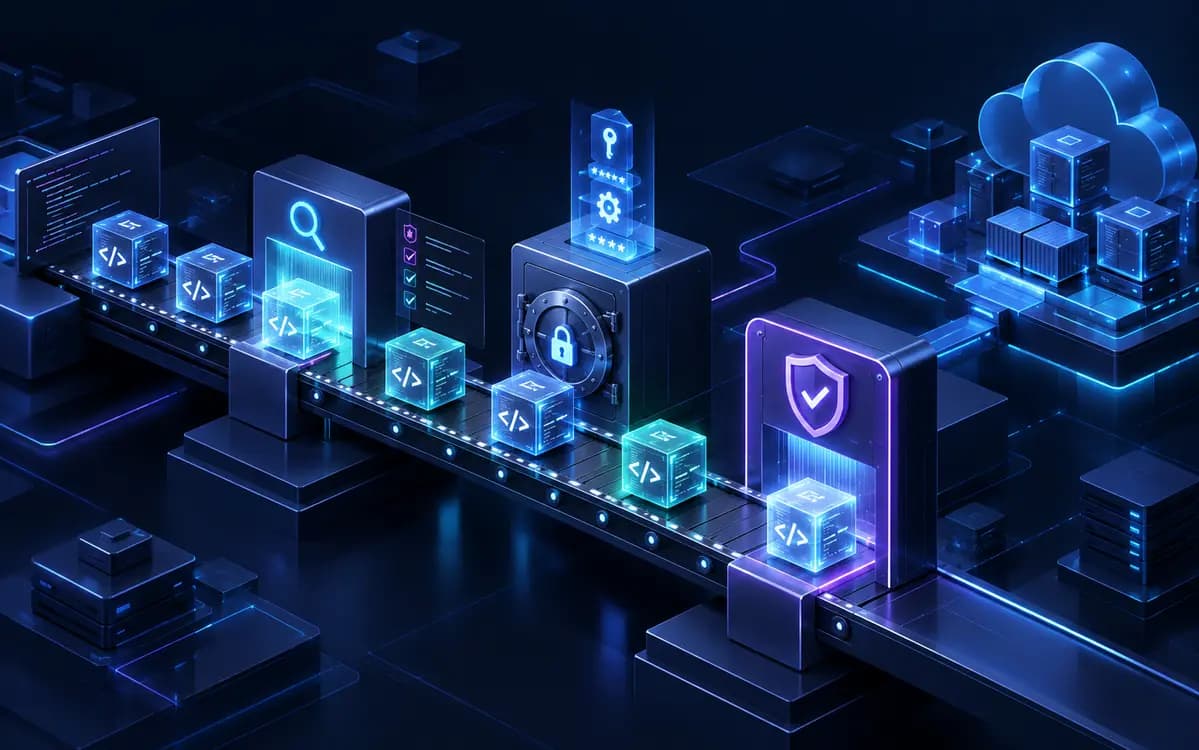
Place controls where they have the best context. Pre-commit and pull-request checks can detect secrets, formatting problems, and obvious insecure patterns. Build stages can run SAST, software composition analysis, IaC scans, generate an SBOM, and build an image. Registry or promotion stages can scan the image and validate provenance. Deployment stages can enforce policy, least-privilege environment identity, signed artifact requirements, and change approval. Runtime monitoring closes the loop with audit, detection, and vulnerability response.
Production implementation guidance
Start with a small set of high-signal controls: secret scanning, dependency vulnerability review, IaC checks, image scanning, and protected branches. Define severity thresholds and exception process so teams know which findings block release and how to document a justified temporary exception. Produce an SBOM with the artifact and preserve build provenance. Use a trusted registry, immutable digests, and where supported, artifact signing or attestation. Remediation should create owned work with due dates rather than an ignored scan dashboard.
Security and change-control considerations
CI/CD roles should use federation or short-lived credentials, scoped by repository, branch, environment, and action. Separate the identity that reads source from the identity that deploys production. Keep secrets in a managed store, mask them in logs, rotate them, and prevent untrusted pull requests from accessing privileged variables. Audit pipeline configuration, environment approvals, artifact promotion, and deployment actions because the pipeline is part of the production attack surface.
Performance, monitoring, and operational considerations
Security gates must be reliable and fast enough that teams do not route around them. Track false positives, scan duration, remediation age, exception expiry, and recurring root causes. Maintain runbooks for exposed secret response, vulnerable base image replacement, dependency emergency patching, and compromised CI identity. Runtime detection and cloud audit logs provide context that build-time scans cannot.
Production delivery and verification
Before changing a live $devsecops: adding security to your ci/cd pipeline design, record the current baseline: ownership, dependency map, service objective, capacity or policy limit, and the signals that would prove the change helped. A change without a baseline is difficult to validate and easy to misattribute after the next deployment or traffic shift.
Make the smallest reversible change first. Test it in a representative non-production environment, then release with a bounded blast radius, a named owner, and a rollback condition. Change windows are not a substitute for safety; the practical controls are an identified previous state, compatible data or configuration, and a clear decision point for stopping the rollout.
During and after release, correlate infrastructure signals with the user journey. Watch error rate, latency, saturation, availability, and the workload-specific signal that prompted the work. Record the observed outcome in the engineering decision log. This turns a one-off fix into operational knowledge that can be reused during planning, incident response, and the next review.
Finally, keep the runbook current. It should state what normal looks like, what breaks first, who owns the dependency, how to collect evidence, and which action is safe under pressure. Good documentation is concise enough to use during an incident and specific enough to prevent an unsafe guess.
Decision guidance
Introduce controls in the order that reduces real risk without paralyzing delivery. Protect identities and secrets first, then artifact and dependency integrity, then policy depth. A mature program measures whether controls prevent or shorten exposure rather than simply counting findings.
Related technical reading: How to Build a Production-Ready CI/CD Pipeline · Docker in Production: Security and Reliability Checklist
Practical implementation checklist
- Use protected branches and short-lived, least-privilege pipeline identities.
- Scan secrets, source, dependencies, IaC, and container images.
- Generate SBOMs and promote immutable artifacts by digest.
- Define blocking thresholds, exceptions, owners, and remediation timing.
- Retain audit evidence and connect runtime findings to delivery provenance.
Frequently asked questions
Will scanning every commit slow delivery?
Some checks cost time, so use fast checks early and deeper scans at appropriate gates. Cache safely and focus blocking policies on high-confidence risk.
What is an SBOM for?
It records components in an artifact, helping teams identify exposure when a dependency vulnerability is disclosed.
Can security be fully automated?
Automation improves consistency, but risk acceptance, architecture trade-offs, and incident response still need accountable human decisions.