DevOps · 8 min read
How to Build a Production-Ready CI/CD Pipeline
A delivery pipeline should make change safer, faster, and easier to explain.
Fundamentals and why this matters
A production CI/CD pipeline is a controlled path from a reviewed change to a measurable production outcome. It should shorten feedback without making security or recovery an afterthought. The important unit is not a YAML file; it is a delivery system that produces an identifiable artifact, validates it in progressively realistic environments, limits credentials, records approvals where needed, and can stop or reverse a harmful release.
Architecture and important components
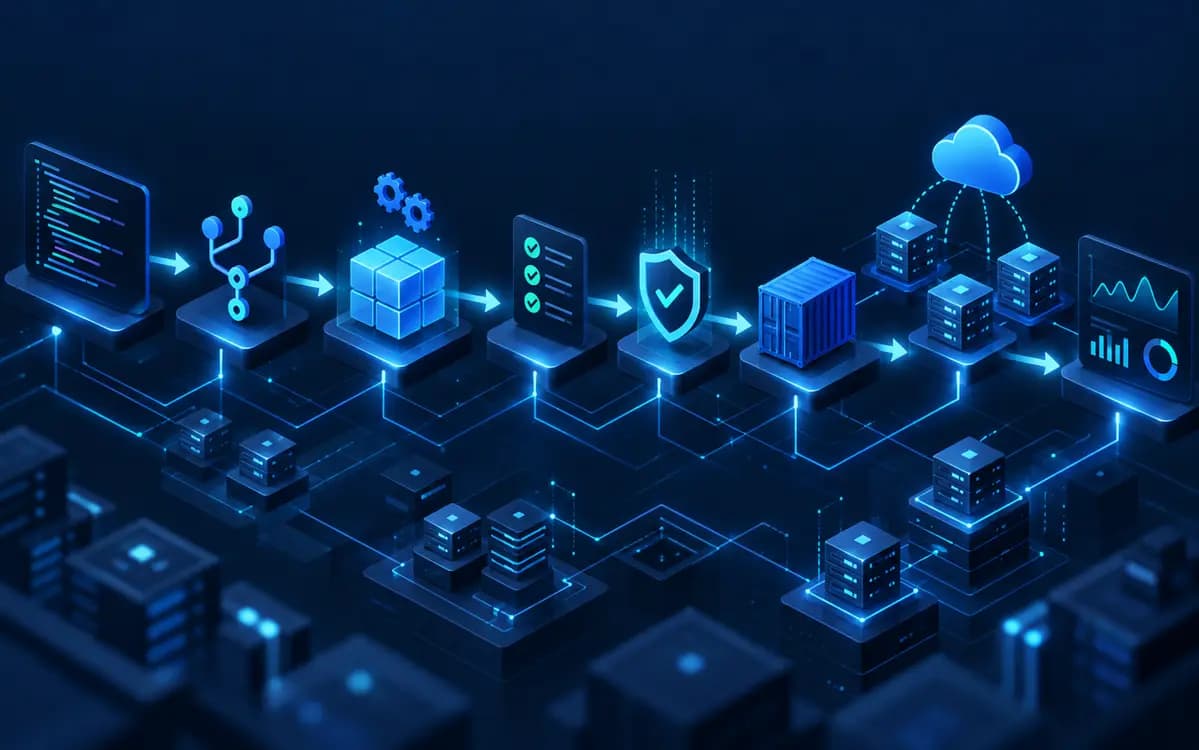
A typical path is commit, pull request, lint and unit tests, dependency and secret scanning, build, container image scan, artifact publication, staging deployment, integration tests, approval or policy gate, production deployment, and post-deploy verification. Source control records intent; the artifact registry records what was built; deployment automation records where it went; monitoring establishes whether it is healthy. Environments should consume the same immutable artifact by digest, with configuration supplied at deploy time.
Production implementation guidance
Make pull-request checks fast and deterministic. Fail early on formatting, tests, exposed secrets, or known critical vulnerabilities. Build once after merge, attach version and commit metadata, and push to a private registry. Deploy to staging with isolated configuration, exercise migrations and integration paths, then promote the exact digest to production. Use rolling, blue-green, or canary deployment according to blast-radius tolerance. A canary needs metrics and a stop condition; blue-green needs a tested traffic switch; rolling needs readiness and capacity headroom.
Security and change-control considerations
CI systems are privileged supply-chain components. Use short-lived credentials, branch protection, environment-scoped secrets, least-privilege deploy roles, and separate build from deploy permissions. Scan dependencies, IaC, and images, but make findings actionable. Sign or attest artifacts where the ecosystem supports it. Never place long-lived cloud keys in pipeline variables when workload identity or federation is available.
Performance, monitoring, and operational considerations
A deployment is incomplete until it is observed. Emit release annotations, version labels, and links to the change. Monitor error rate, latency, saturation, queue depth, and business-critical transactions during the rollout. Define automatic and manual rollback conditions before release day. Database migrations deserve separate treatment: prefer backward-compatible expand-and-contract changes, back up before destructive work, and make application versions compatible across the transition.
Production delivery and verification
Before changing a live $how to build a production-ready ci/cd pipeline design, record the current baseline: ownership, dependency map, service objective, capacity or policy limit, and the signals that would prove the change helped. A change without a baseline is difficult to validate and easy to misattribute after the next deployment or traffic shift.
Make the smallest reversible change first. Test it in a representative non-production environment, then release with a bounded blast radius, a named owner, and a rollback condition. Change windows are not a substitute for safety; the practical controls are an identified previous state, compatible data or configuration, and a clear decision point for stopping the rollout.
During and after release, correlate infrastructure signals with the user journey. Watch error rate, latency, saturation, availability, and the workload-specific signal that prompted the work. Record the observed outcome in the engineering decision log. This turns a one-off fix into operational knowledge that can be reused during planning, incident response, and the next review.
Finally, keep the runbook current. It should state what normal looks like, what breaks first, who owns the dependency, how to collect evidence, and which action is safe under pressure. Good documentation is concise enough to use during an incident and specific enough to prevent an unsafe guess.
Decision guidance
Optimize the workflow around risk, not maximum automation theater. A low-risk documentation change and a database schema migration should not have identical gates. Keep the pipeline understandable enough that an on-call engineer can explain the current artifact, environment, approval state, and rollback action during an incident.
Related technical reading: DevSecOps: Adding Security to Your CI/CD Pipeline · Docker in Production: Security and Reliability Checklist
Practical implementation checklist
- Protect branches and require reviewed pull requests.
- Build once and promote immutable artifacts by digest.
- Run tests and scans at the earliest useful stage.
- Use short-lived, least-privilege CI/CD identities.
- Verify production with real health and business signals, then retain a proven rollback path.
Frequently asked questions
Should production always require manual approval?
Not necessarily. Approval should match risk and control requirements; automated policy gates can be stronger and faster for routine changes.
What makes a rollback reliable?
A known prior artifact, compatible configuration and schema state, explicit traffic behavior, and monitoring that detects whether rollback is required.
Where should secrets live?
In a managed secrets system or environment-specific secret store, injected just in time—not in source, images, or long-lived CI variables.